
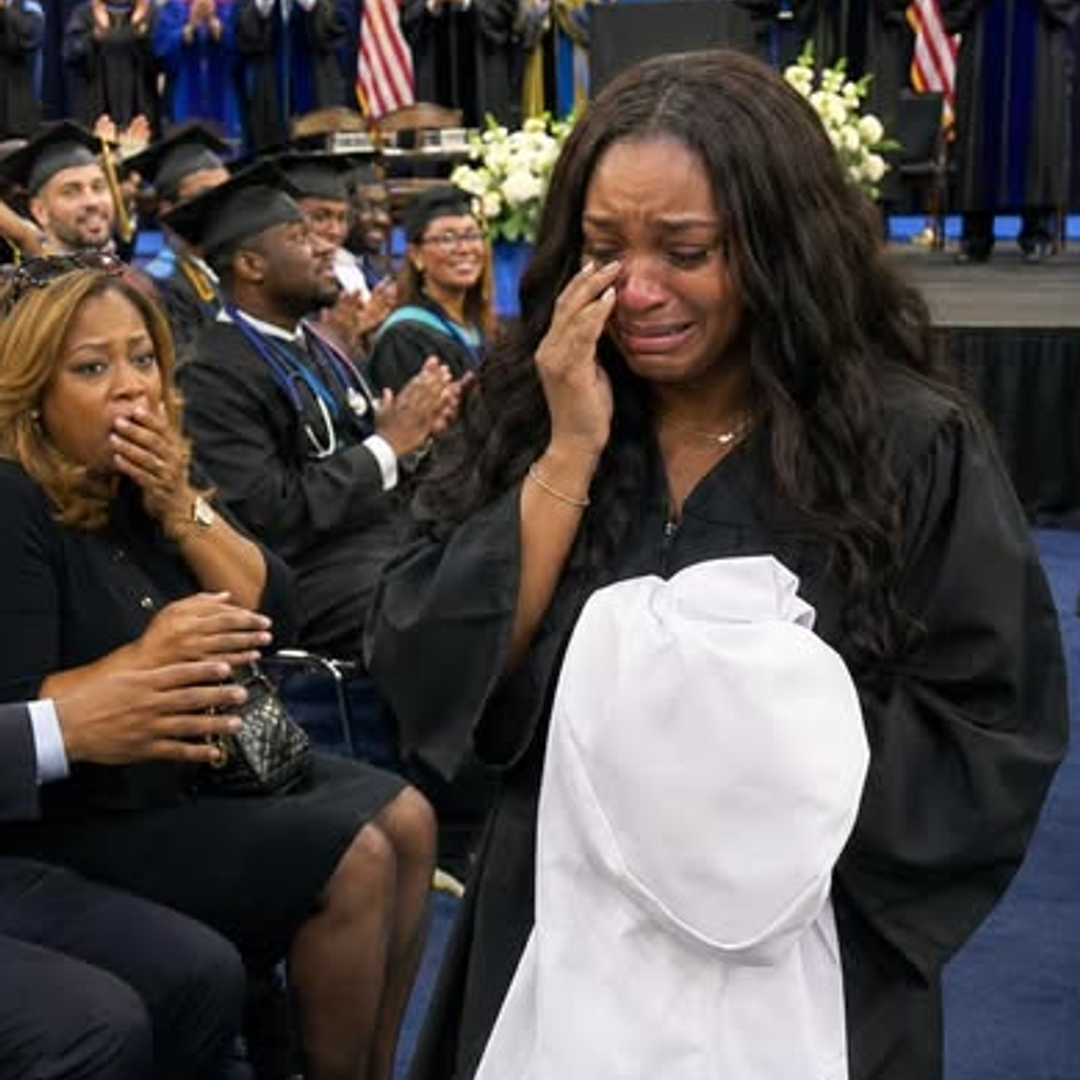
At My Graduation, the Parents Who Abandoned Me During C.a.n.c.e.r Treatment Sat in the Reserved Family Section Like They Had Earned My Success — Then the Dean Announced the Valedictorian The moment I saw my biological parents sitting in the reserved family section at my graduation, I knew they still believed they had done nothing wrong. My white coat rested folded across my lap. The embroidered name was hidden. Behind me, the same people who had walked away fifteen years earlier were smiling for photographs as though they had helped me reach this day. Then I heard my mother whisper: “She owes us this moment.” I didn’t turn around. The auditorium at Westhaven College of Medicine smelled of polished floors, fresh coffee, and newly printed graduation programs. I had imagined this day for years. I thought reaching it would bring nothing but relief. Instead, my past was sitting three rows behind me. Margaret Bennett—the woman who gave birth to me—sat beside my biological father, Thomas. My older sister, Sophie, occupied the aisle seat with her phone already raised for pictures. All three behaved as though they belonged there. As though fifteen years had somehow erased what happened. They smiled at strangers. Accepted congratulations. Then Margaret repeated, just loudly enough for me to hear: “After everything, Claire owes us this.” Some words hurt because they surprise you. Others hurt because they prove the people responsible still don’t understand what they did. Fifteen years earlier, I was thirteen years old, sitting in Room 314 at Willowcrest Medical Center in Bellmere. My feet barely touched the floor. Dr. Adrian Reed sat across from my parents holding a tablet, preparing to say the words that divided my childhood into before and after. “It’s acute lymphoblastic leukemia.” The room seemed to tilt. He explained that it was one of the more common forms of childhood c.a.n.c.e.r and that aggressive treatment offered a strong chance of recovery. I heard treatable. I heard strong chance. Then I waited for Mom to hold my hand. For Dad to tell me we would face it together. Instead, Thomas asked: “How much?” Dr. Reed explained that treatment could last two to three years and that out-of-pocket costs might reach sixty to one hundred thousand dollars, although assistance programs were available. Dad gave a bitter laugh. “So we could spend a hundred thousand dollars because she got sick?” Then he started talking about Sophie. She was sixteen. Applying to elite universities. My parents had already saved $180,000 for her education. “We are not wiping out her future over this,” Thomas said. I looked at Mom. She said nothing. Then Dad finally looked directly at me. “Sophie has potential. She’s brilliant and focused.” He paused. “You’ve always been average, Claire. We’re not sacrificing one promising future for an average one.” The diagnosis terrified me. But hearing my own parents calculate my worth hurt somewhere deeper. “I’m your daughter too,” I whispered. Dr. Reed abruptly stood. “I need both of you to leave while I speak with Claire privately.” Margaret frowned. “We’re her parents.” “Leave,” he said firmly, “or I’m contacting security and social services.” They walked out. No hug. No hand on my shoulder. Not even an “I love you.” Within hours, emergency custody paperwork was underway, and the state became responsible for the child my parents had decided was too expensive to support. That night, I lay beneath the medical-center lights listening to machines beside my bed. I wasn’t only afraid of what the illness might do to me. A worse thought kept circling through my mind. Would my parents actually feel relieved if I never came home? Then Lily Carter walked into my room. She was thirty-four. Dark curls. Blue scrubs. Worn sneakers. And none of the fake cheer adults sometimes used around frightened children. “Hey, Claire,” she said quietly. “I’m Lily. I’m your night nurse.” I turned toward the window. “I feel terrible.” Lily didn’t tell me to be brave. She simply pulled up a chair. “I heard what happened today,” she said. “And I’m sorry.” That was when I cried. Lily stayed. Later, she returned with crackers and a deck of cards. We played until almost two in the morning. She told me about her overweight cat, Muffin, and about her younger brother, who had gone through leukemia years earlier. That experience was one reason she had become a nurse. My parents didn’t return the following day. Or the following week. As treatment took away my appetite, strength, and hair, Lily kept showing up. Clean blankets. Terrible jokes. Medication reminders. And a kind of steady patience I had stopped expecting from adults. Twenty-eight days after my diagnosis, Dr. Reed told me the treatment was working well enough that outpatient care could begin soon. A social worker named Emma Brooks came into my room and explained that they had located a foster placement. Lily was standing beside my bed. She wasn’t even scheduled to work that day. “I want to take her,” she said. Emma stared at her. Lily repeated herself. “I want to foster Claire. I’m already state-approved, and I understand her medical needs.” Emma explained the responsibility. Appointments. Medication. School plans. Emergency care. Paperwork. Everything. Lily listened without hesitation. Then she turned toward me. “Only if you want to come home with me.” For the first time since my parents walked out of Room 314, I felt something stronger than fear. “Yes,” I whispered. “Please.” I didn’t understand it then, but that single answer would change far more than my address. The woman who had entered my medical-center room as my night nurse was about to give me what my biological family had decided I wasn’t worth giving. A home. A family. And eventually... her name. (I know everyone’s desperate to know what the messages said… so if you want full story, leave a “YES” below!) See less
